Category Archives: Cooking
Cooking Oil: So hot it’s smokin’

That's right, I'm talkin' to YOU.
So it occurs to me that you might not be completely clear on smoke points for cooking oils, which can not only be dangerous from a flash point perspective, but also in terms of the havoc a pan full of flaming oil can wreack when you’re trying to get a damned meal on the table without burning down the house. Pardon me if you already know this stuff. Perhaps you’d like to revisit an earlier post or contemplate the baffling appeal of Erik Estrada while the rest of us discuss it.
Here we go. Cooking oils will begin to smoke at different temperatures. You don’t want oils to smoke. TV cooks may tell you that the oil in a pan needs to be on the verge of smoking, but I have never been able to pull back or avoid a conflagration once I’m that close to the edge. Too tempting. “Just a little higher, baby. Just two or three degrees more. C’mon. C’MON!” And before you can say “Freeze! LAPD!” the smoke detector is screaming, the pan’s on fire and your eyebrows are gone.
For an all-inclusive list of oils and their smoke points, check Wikipedia. It’s confusing, but complete.
For those of you with limited attention spans, these are my rough guidelines. All temps are approximate and in Fahrenheit. I have no idea what Celsius equivalents are, and I don’t care.
- As a rule the more refined the oil is, the more heat it can take and the milder its flavor. There are exceptions, but I’m not going to get into them here. I just don’t get that deep.
- Lowest smoke points are butter (350 degrees), lard (360-400) and most unrefined oils.
- Generally olive oil (365-400 or so) can take more heat, but it varies according to purity and the amount of refining.
- Other high-heat, refined oils are grapeseed (420-485), canola (400-435), sesame (410-450), peanut (440-450), corn (410-450), avocado (520) and vegetable.
If you want to sere something, use a high heat oil. To add butter flavor, mix butter with an oil that has a higher tolerance, but be careful of flavors – for example dark (or toasted) sesame oil can add a strong flavor, while corn oil has very little taste.
Zut alors! You must make the béchamel

ROUX (courtesy persnicketypicnic.blogspot.com)
You really can’t cook well, or even passably, without knowing how to make a roux (pronounced ROO) and the resulting sauces. For our friends in France (those clever cuisiniers who fill their éclairs with chocolate cream – genius!) there are several basic (or mother) sauces that form the foundation of French cooking, and for my money, there’s no better food on the planet. They are white sauce (aka béchamel), velouté, espagnole, hollandaise, mayonnaise and vinaigrette.
Now we’ve discussed vinaigrette, which is probably the most commonly used sauce day to day. At least that was what I thought before my recent trek through the heartland, which is why I think we all need to take a look at white sauce. If you all are consuming condensed soups at the rate it appears you are, we need to revisit this, the simplest of sauces. It is so much better than anything from a can and so easy to make. Look!
How ’bout some cheese with those fries?

If you’re familiar with my culinary ramblings, you’ll recall that I have a soft spot for the cuisine of the atomic age: casseroles, Jell-O, turkey divan and such. And until recently – like yesterday – I had thought that this kind of food had met a fate similar to that of Latin: more or less dead and just kind of limping along in places no one wanted to go, like church services and criminal court. Well, it’s easier to come by than you might think, and I’m big enough to admit I was wrong. In fact, after two days at the trough in Ohio I’m also big enough to land a fighter jet on.
That’s correct, I’ve just finished up a mini-tour through the heartland where the trees are turning, the air is clean, and the folks are unfailingly friendly. Unfortunately the coffee is thin, the gravy is white and apparently the Velveeta runs like a river through the entire region. Now, I have it on good authority that there is plenty of good food to be found in corn country, but I cannot honestly say that I encountered much.
Nigella: You knew it would come to this sooner or later
 Love her or hate her, Miss Lawson is for many the original short-cut taking, taste-as-you-go then eat-with-abandon kitchen slattern, and for that alone I will always be a fan. I stumbled upon Nigella Bites in 2001 and loved the show’s clever editing, Nigella’s girlfriend-y chatter and her refreshingly relaxed approach to both cooking and eating.
Over the years, however, as the domestic goddess juggernaut picked up steam, I began to feel a creeping unease, and by the time we got to Nigella Express in 2007, the experience of watching her cook had begun to make me squirm, and not in a good way. With adjectives multiplying like randy bunnies and the chatter taking on a, how shall I say, slightly overheated feel, the experience became more than I could reasonably endure, at least without a partner.
Witness the foreplay for a chocolate raspberry pavlova recipe:
“You just cannot beat a pav in summer, and in particular this dark beauty. The crisp and chewy chocolate meringue base, rich in cocoa and beaded nuggets of chopped plain chocolate, provides a sombre, almost purple-brown layer beneath the fat whiteness of the cream and matt, glowering crimson raspberries on top: it is a killer combination.”
Ooh, sorry. I just slid off the glistening seat of my rigid ebony desk chair, the fat whiteness of my pale, billowing ass tumbling with a surprising, yet somehow satisfying, plop onto the plush, mellow lusciousness of the ruby and citron carpet below.
Oh God, it’s happening again and all I’ve been looking at are YouTube videos.
My recommendation: Like that of the Rolling Stones, Nigella’s early work in both print and video is by far the best. Her cookbooks are worth buying, since most include several very good recipes and some great tips, for instance, when she suggests roasting beets rather than boiling them or serving deep fat fried Mars bars to your girlfriends, and don’t even think of telling me this does not appeal. If it doesn’t, you’re either hanging with the wrong crowd or need to get to Walmart more often, or both.
From Nigella Bites: Gingery-hot duck salad (because I find duck fat repulsive, I peel it off, melt a little in the pan to cook the duck, then chuck it as soon as humanly possible – up to you) and Vietnamese chicken and mint salad are fabulous, as is the recipe for Italian sausages and lentils.
In Forever Summer I like the cold beet soup. The slow cooked lemon garlic chicken is a real winner, too. The method is foolproof for producing meat that slides off the bone, though I usually omit the lemon and brush on barbecue sauce before the final high heat cooking time. Sticky, sweet and salty? You bet. That’s just the way I roll, but you may prefer the original.
Nigella and I part ways on the issue of mixing red and green ingredients in salads — I’m all for it, and I cannot urge you strongly enough to avoid the carrot and peanut salad; I tried it during my early, true-believer phase and it’s as delicious as it sounds. And let’s not even get into the watermelon, olive and feta salad. Even at the height of my fanaticism, I never even considered that one, no matter how convincing her argument in favor. Ugh.
And what is pavolva anyway?
Meet Mr. Wonderful
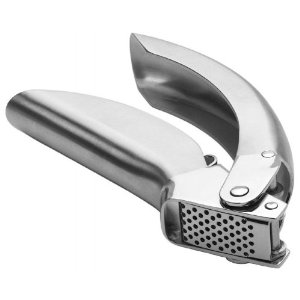 I don’t care what those TV chefs say, a garlic press is a girl’s best friend. It saves time and trouble, keeps your hands smelling fresh and preserves your manicure. No slattern should be without one.


 Kitchen Slattern